Essays in Political Philosophy by R. G. Collingwood
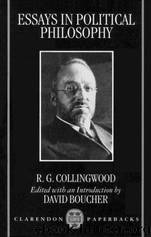
Author:R. G. Collingwood [Collingwood, R. G.]
Language: eng
Format: epub
Tags: Philosophy, General, History & Surveys, Political Science, Political, History & Theory, World Politics
ISBN: 9780198235668
Publisher: Oxford University Press, USA
Published: 1995-04-15T06:34:17+00:00
to follow out a plan is a real power, something involving more rationality and therefore more freedom than the simple power to do what we like at any given moment; and if we give up the greater for the sake of the less, we gain nothing.
A plan consists of acts organized into a coherent whole; but it must be remembered that no plan consists of a definite finite number of acts; and that any act, however trifling, is already a plan and contains in itself a diversity of lesser acts. However far one pushes the analysis of a plan into its component parts, one never reaches an atomic act which cannot be subdivided. And similarly, however far one goes in adding act to act and forming more and more complex plans, every plan that really is a plan has the simplicity and unity of a single act. The entire plan, however extensive it may be, is put into effect by a single and indivisible act of will. This follows from the general nature of mind, and is familiar in ordinary reflection. No one thinks that it is possible to say how many acts precisely are involved in such a thing as the establishment of the Principate by Augustus. Everyone sees that such a thing is one act, within which we may distinguish however many component parts we like. The whole act falls of itself into certain main elements or phases, and the distinction between these is not arbitrary; what is arbitrary is the point at which our subdivision is arrested. Action which is explained or determined in this way, by reference to a plan consisting of a single action differentiating itelf into parts, or various actions uniting into a whole, is being considered, as a logician would say, in terms of quantity. Logical quantity is the determination of judgements as universal and particular; the categories involved are those of unity and plurality, which, in relation to their synthesis totality, become the moments of whole and part. A plan is a whole, a unity, of which a single act is a part, one of the plurality which compose the unity. And since the logical moments unity and plurality are transcendental, every act must be a plan and every plan an act; there can be no plurality which is not a unity, and no unity which is not a plurality.
It is this conception of quantity in action which forms the philosophical root of politics. Politics means the organization of activities. Empirically, it is the name for the particular kind of work which is done by a particular kind of organization called the state; but the state may do other things besides politics, for instance, it may carry on trade or scientific research: and on the other hand a great deal of political work in the proper sense of the word is carried
-112-
Download
This site does not store any files on its server. We only index and link to content provided by other sites. Please contact the content providers to delete copyright contents if any and email us, we'll remove relevant links or contents immediately.
| Anthropology | Archaeology |
| Philosophy | Politics & Government |
| Social Sciences | Sociology |
| Women's Studies |
The remains of the day by Kazuo Ishiguro(9094)
Tools of Titans by Timothy Ferriss(8501)
Giovanni's Room by James Baldwin(7441)
The Black Swan by Nassim Nicholas Taleb(7200)
Inner Engineering: A Yogi's Guide to Joy by Sadhguru(6839)
The Way of Zen by Alan W. Watts(6675)
The Power of Now: A Guide to Spiritual Enlightenment by Eckhart Tolle(5856)
Asking the Right Questions: A Guide to Critical Thinking by M. Neil Browne & Stuart M. Keeley(5838)
The Six Wives Of Henry VIII (WOMEN IN HISTORY) by Fraser Antonia(5560)
Astrophysics for People in a Hurry by Neil DeGrasse Tyson(5227)
Housekeeping by Marilynne Robinson(4507)
Double Down (Diary of a Wimpy Kid Book 11) by Jeff Kinney(4339)
12 Rules for Life by Jordan B. Peterson(4333)
Ikigai by Héctor García & Francesc Miralles(4313)
The Ethical Slut by Janet W. Hardy(4311)
Skin in the Game by Nassim Nicholas Taleb(4311)
The Art of Happiness by The Dalai Lama(4170)
Skin in the Game: Hidden Asymmetries in Daily Life by Nassim Nicholas Taleb(4053)
Walking by Henry David Thoreau(4004)
